
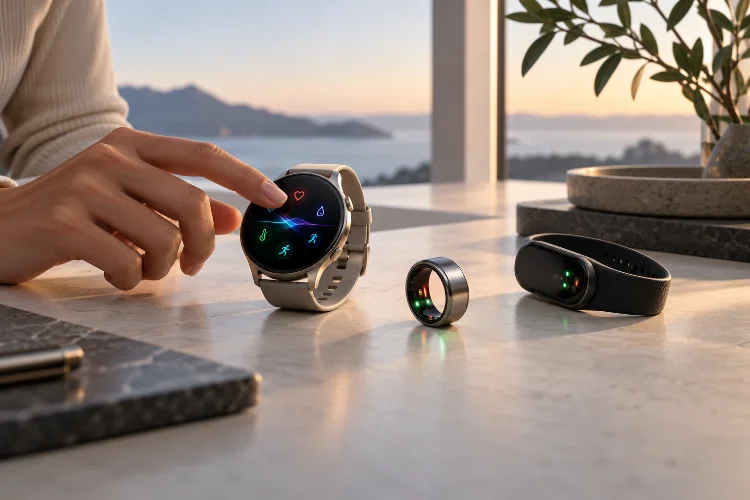
Wearable electronics used to be relatively simple. Early fitness trackers counted steps, estimated distance, and perhaps displayed basic heart-rate information.
Today’s smartwatches and rings can combine optical sensors, electrical heart monitoring, temperature sensing, motion tracking, oxygen saturation measurements, and increasingly sophisticated software analysis.
That shift explains why advanced wearable sensor technologies changing personal electronics are becoming one of the most interesting areas of consumer technology.
The real innovation is not simply adding more sensors. Modern devices combine several streams of information to understand context.
Motion data can help distinguish exercise from rest, while optical signals, temperature trends, and heart-rate variability can contribute additional information about sleep or recovery. Current wearables already demonstrate this multi-sensor approach.
Apple’s latest Watch hardware combines optical and electrical heart sensors with temperature, accelerometer, gyroscope, and other environmental sensors, while Google’s Pixel Watch platform combines optical, electrical, temperature, oxygen-sensing, motion, and skin-conductance hardware.
The result is personal electronics that increasingly understand the person wearing them, not just the commands they receive.
Optical Sensors Have Become Much More Sophisticated
Optical heart-rate sensing remains one of the foundations of modern wearable technology.
Most watches use photoplethysmography, commonly called PPG. LEDs shine light into the skin while photodetectors measure changes in reflected light caused by blood-volume changes beneath the surface.
From those signals, software can estimate heart rate and derive additional metrics.
Modern implementations have become more complex than the simple green LED systems used by early fitness trackers. Google’s current Pixel Watch hardware, for example, includes a multi-path optical heart-rate sensor plus red and infrared sensors used for SpO₂ monitoring.
Researchers increasingly treat optical sensing as part of a wider physiological monitoring platform rather than an isolated heart-rate sensor. A recent review of wearable health sensors identifies optical systems as important for measurements such as heart rate and oxygen saturation.
Accuracy still depends on factors including movement, skin contact, sensor placement, algorithms, and environmental conditions.
That is why combining optical information with motion and electrical sensing can be more valuable than relying on one sensor alone.
ECG Sensors Bring Electrical Heart Signals to the Wrist
Optical monitoring observes changes in blood flow. ECG sensing measures the electrical activity associated with the heart itself.
Consumer wearables generally use a limited number of electrodes rather than the multi-lead systems used in clinical settings. The user may touch a watch crown or electrode while another electrode contacts the wrist, completing the electrical circuit.
That makes short, single-channel ECG recordings possible from a compact wearable.
Apple Watch models with ECG capability use an electrical heart sensor alongside optical sensing. Current Pixel Watch hardware similarly includes multipurpose electrical sensors compatible with its ECG application.
The FDA notes that consumer wearables can provide heart-rate and rhythm information and that some approved software can identify signs associated with conditions such as atrial fibrillation. However, these notifications are not the same thing as a complete medical diagnosis.
This distinction matters.
Wearable ECG has made cardiovascular information dramatically more accessible, but the value comes from useful monitoring and early signals – not from pretending a watch replaces comprehensive clinical equipment.
Temperature Sensors Add Context Instead of Just Another Number
Skin-temperature sensing is another technology becoming common in premium wearables.
Unlike a traditional thermometer, many wrist-based systems are designed primarily to observe changes relative to a user’s normal baseline rather than produce one isolated body-temperature reading.
That can make temperature data more useful when combined with sleep, activity, heart rate, or other metrics.
Current Apple Watch hardware includes a temperature sensor, while Google’s Pixel Watch platform uses a far-field skin-temperature sensor.
This illustrates a wider trend in wearable design: sensors are increasingly valuable because of the relationships between measurements.
A small temperature change on its own may mean very little. A persistent deviation combined with changes in resting heart rate, sleep quality, or movement patterns may provide more useful context.
Future wearable systems will likely become even better at interpreting these relationships instead of overwhelming users with continous streams of raw numbers.
Motion Sensors Are Still Among the Most Important Components
Accelerometers and gyroscopes may sound less exciting than ECG or biochemical sensing, but they remain fundamental to wearable electronics.
An accelerometer measures changes in movement and acceleration, while a gyroscope detects rotational motion. Combined into an inertial measurement system, they can estimate activity, orientation, gestures, exercise patterns, and movement quality.
Modern wearable products commonly integrate both.
More importantly, research shows that inertial sensors are already useful beyond simple step counting.
A 2025 systematic review covering 72 studies and 7,949 participants found that accelerometers, gyroscopes, and other inertial sensors were widely used for continuous movement monitoring, particularly in neurological applications.
Motion data can also improve other sensors.
During a hard workout, for example, wrist movement can interfere with an optical heart-rate signal. An algorithm that understands how the wrist is moving has additional information it can use when interpreting noisy optical readings.
The humble accelerometer is therefore becoming part of a much larger sensor-fusion system.
Bioimpedance Expands Wearables Beyond Heart Monitoring
Bioelectrical impedance analysis, or BIA, shows how wearables are expanding into entirely different categories of measurement.
BIA sends a very small electrical current through the body and measures the resulting electrical impedance. Algorithms then use those measurements alongside other information to estimate body-composition metrics.
Samsung has integrated BIA into several Galaxy Watch generations.
Its current support documentation explains that compatible Galaxy Watches can use BIA to estimate measurements such as body-fat percentage, body-water content, and skeletal-muscle mass.
Samsung also explicitly describes these features as intended for general wellness and fitness rather than medical diagnosis.
The interesting part is not whether wrist-based BIA can replace specialised laboratory equipment – it cannot.
The important development is that a device small enough to wear all day can now contain optical heart sensing, electrical cardiac sensing, movement detection, temperature measurement, and electrical impedance capabilities at the same time.
That would have been an unusually complex collection of instruments not long ago.
Skin Conductance Can Reveal Another Layer of Body Response
Wearables are also beginning to monitor changes in the electrical properties of the skin.
Electrodermal activity, sometimes measured using continuous electrodermal activity or cEDA sensors, is associated with changes in sweat-gland activity. Those changes can occur alongside physiological arousal.
Current Pixel Watch hardware includes an electrical sensor for measuring skin conductance as part of its body-response tracking features.
Like many wearable metrics, this information becomes more useful when interpreted alongside other signals.
A change in skin conductance might coincide with movement, heart-rate variation, sleep disruption, or a stressful event. Sensor fusion allows software to evaluate several measurements together rather than making conclusions from one imperfect signal.
This is an important direction for personal electronics.
The next major improvement may not come from discovering one magical new sensor. It may come from combining five moderately useful sensors into one much more informative system.
Flexible Sensors Could Change the Shape of Wearables
Most consumer wearables today are watches, rings, earbuds, or compact patches.
Flexible electronics could broaden that dramatically.
Research into flexible and stretchable sensing platforms aims to create sensors that conform more naturally to the irregular shape of the human body.
Recent reviews describe progress in wearable devices that can monitor physiological, biochemical, and environmental signals while improving comfort and skin contact.
That could lead to electronics embedded into adhesive patches, clothing, rehabilitation equipment, footwear, or other surfaces.
Better skin conformity also has a practical measurement advantage.
A rigid sensor moving independently from the body can introduce noise. A flexible sensor that maintains stable contact may potentially collect cleaner information in certain applications.
Current challenges include durability, manufacturing complexity, energy consumption, material stability, and long-term reliabilty.
Still, flexible sensors suggest that the future wearable may not look like a watch at all.
Biochemical Sensing Is the Next Major Frontier
One of the most ambitious goals in wearable technology is measuring biochemical information continuously.
Researchers are exploring sensors capable of analysing sweat, interstitial fluid, and other biological signals for biomarkers that cannot be captured through conventional motion or optical sensing.
A 2026 review of wearable health-monitoring systems highlights ongoing progress in devices capable of detecting biochemical analytes as well as physiological measurements.
This could eventually expand personal electronics into areas far beyond today’s fitness trackers.
However, consumers should be careful about confusing experimental research with commercially validated products.
The FDA has specifically warned against smartwatches and smart rings claiming to measure blood glucose directly without piercing the skin.
The agency states that it has not authorized, cleared, or approved any smartwatch or smart ring that independently measures or estimates glucose in this way.
That is a useful reminder that exciting sensor concepts still require serious validation before they become trustworthy health tools.
AI Is Turning Sensor Data Into Useful Information
More sensors create a new problem: huge amounts of data.
A wearable can sample motion, pulse signals, temperature, sleep behaviour, electrical activity, and other variables throughout the day. Raw streams of numbers are not particularly helpful to most people.
Machine learning helps translate them into patterns.
Recent research reviews identify AI and machine learning as increasingly important for interpreting wearable data, detecting patterns, and supporting personalised monitoring.
The key shift is from measurement to interpretation.
Instead of saying your heart rate was 62 beats per minute at 7:12 a.m., a system might identify that several weeks of sleep, activity, temperature, and cardiovascular trends have changed together.
On-device processing can also help reduce dependence on cloud computation and potentially keep more sensitive information local.
The challenge will be maintaining accuraccy while making algorithms understandable, energy-efficient, and appropriately cautious about what their predictions actually mean.
Advanced wearable sensors are transforming personal electronics from passive accessories into systems capable of continuously observing movement, cardiovascular signals, temperature, body composition, skin responses, and other physiological information.
The biggest advances are increasingly happening through sensor fusion. Optical monitors, ECG electrodes, inertial sensors, temperature systems, BIA hardware, and AI algorithms can complement one another and provide more useful context than any individual measurement.
Flexible and biochemical sensors could push the category even further, although many emerging technologies still need significant validation before reaching mainstream use.
When evaluating future wearables, look beyond the number of sensors listed on the box. Pay attention to what they actually measure, how those measurements are validated, and how intelligently the device combines the data.
That is where the next generation of personal electronics will become genuinely useful.