
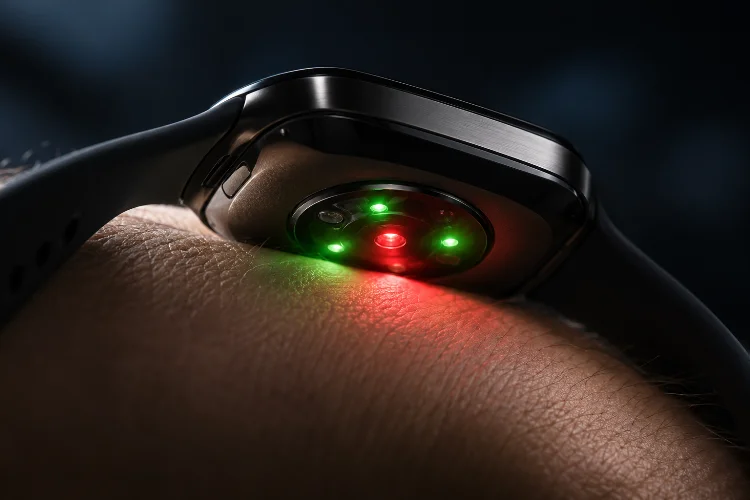
Turn over a modern smartwatch and you will probably see a cluster of tiny LEDs flashing against your skin.
Those lights may look simple, but they are part of a surprisingly sophisticated sensing system capable of tracking cardiovascular signals throughout the day and night.
Understanding how optical sensors measure health metrics in modern wearables starts with a technology called photoplethysmography, or PPG.
Instead of directly “seeing” the heart, an optical wearable sends light into the skin and measures subtle changes in the light that returns. Those changes happen partly because the volume of blood in small vessels rises and falls with each heartbeat.
Modern wearables combine these optical signals with accelerometers, gyroscopes, temperature sensors, and increasingly powerful algorithms. That allows devices to estimate heart rate, heart-rate variability, blood oxygen saturation, and other physiological trends.
However, these readings are still estimates. Movement, skin contact, temperature, pigmentation, tattoos, and sensor placement can all influence signal quality, making good hardware and careful signal processing just as important as the LEDs themselves.
Photoplethysmography Turns Light Into a Pulse Signal
PPG is the core technology behind most optical heart-rate sensors in watches, rings, and fitness bands.
A typical PPG system contains at least two major components: a light-emitting diode and a photodetector. The LED sends light into the tissue, while the detector measures how much light returns.
Blood volume changes slightly every time the heart pumps.
When more arterial blood is present beneath the sensor, light absorption and reflection change. The detector records these repeating variations and converts them into an electrical waveform that corresponds to the pulse.
Scientific reviews describe the PPG waveform as containing both a relatively stable component related to tissue and average blood volume and a pulsatile component associated with each cardiac cycle.
This is why the sensor does not literally count heartbeats by detecting movement.
Instead, it observes rhythmic optical changes caused by circulating blood.
The technique is compact, non-invasive, relatively power-efficient, and practical for continuous monitoring, which explains why it has become so important in consumer wearables.
Green Light Is Particularly Useful for Heart-Rate Tracking
If you have ever noticed green lights flashing beneath a smartwatch during exercise, they are there for a reason.
Green light is strongly absorbed by blood, which can make the pulsatile changes caused by each heartbeat easier for wrist-based sensors to detect.
Apple explains that its optical heart sensor pairs green LEDs with light-sensitive photodiodes. As blood flow increases with a heartbeat, absorption of green light changes; by sampling the signal rapidly, the watch can calculate heart rate.
Research on wearable PPG similarly notes that green wavelengths are commonly used for wrist-based heart-rate monitoring and can provide a strong pulsatile signal.
Modern devices may also change LED brightness or sampling frequency when the signal becomes weaker.
This illustrates why sensor quality involves more than simply installing an LED.
The optical path, detector sensitivity, LED intensity, sampling rate, contact with the skin, and algorithms all influence the final measurment.
A sophisticated wearable continuously adjusts several of these variables according to what the user is doing.
Red and Infrared Light Help Estimate Blood Oxygen
Blood oxygen monitoring requires a different optical approach.
Wearables generally estimate oxygen saturation, or SpO₂, by comparing how blood interacts with different wavelengths of light – typically red and infrared.
Oxygenated and deoxygenated haemoglobin absorb and reflect these wavelengths differently.
Fitbit explains that compatible devices shine red and infrared light into the skin and analyse the reflected signal to estimate blood oxygen saturation. Google currently uses similar red and infrared sensors in its Pixel Watch hardware.
This concept comes from pulse oximetry, which is widely used in clinical environments.
In traditional pulse oximeters, measurements are often taken through a fingertip. Wrist-based wearables generally use reflectance sensing instead, with both the light source and detector positioned on the same side of the tissue.
That makes smartwatch integration practical, but it also introduces challenges.
Scientific literature notes that motion, contact pressure, signal amplitude, and sensor position can all affect wearable SpO₂ measurements.
For this reason, many consumer devices collect oxygen data primarily during sleep or periods of relatively low movement.
Heart Rate Variability Comes From Precise Timing
Heart rate tells you how many beats occur during a minute, but the intervals between those beats are not perfectly identical.
Heart-rate variability, commonly called HRV, analyses these subtle timing differences.
An optical wearable can estimate HRV by identifying individual pulse peaks within the PPG waveform and measuring the time between them. This requires significantly more precision than simply calculating an average heart rate.
Small errors matter.
If movement or poor sensor contact shifts the detected pulse peak by even a small amount, the resulting HRV estimate can become less reliable.
That is why many devices prefer to calculate HRV when the wearer is relatively still, such as during rest or sleep.
PPG research shows that wearable pulse signals can contain considerable cardiovascular information beyond basic heart rate, although extracting that information accurately requires careful signal processing.
This is also why long-term trends may be more useful than obsessing over one isolated value.
A single reading can be noisy. Repeated measurements under similar conditions provide more context.
Motion Is One of the Biggest Problems for Optical Sensors
A wrist is not exactly a quiet environment.
Running, weightlifting, cycling, typing, and even normal arm movements can shift the wearable against the skin. Those movements change the optical path and can create signals that resemble genuine pulse changes.
These unwanted signals are known as motion artifacts.
Modern wearables address the problem through both mechanical design and software.
A secure sensor fit reduces physical movement, while accelerometers and gyroscopes provide information about how the wearable itself is moving.
Research on wearable technology notes that inertial-sensor data can help remove motion-related interference from signals produced by other sensors.
Algorithms can then compare the optical waveform with movement patterns.
For example, if a large change in the PPG signal occurs at exactly the same time as a strong wrist movement, the system may treat part of that signal as noise rather than cardiovascular information.
This sensor-fusion approach is one reason modern wearables can remain useful during workouts.
Still, particularly irregular movement can remain challenging, which is why optical heart-rate accurracy may vary between exercise types.
Skin Contact and Sensor Position Can Change Readings
Optical sensors depend on a reliable physical interface between the device and the body.
A watch worn too loosely can allow ambient light to reach the detector or cause the sensor to move independently from the skin. A strap worn excessively tightly can create different problems by changing local pressure and circulation.
Placement matters as well.
Fitbit advises users to maintain good skin contact and notes that arm position, device fit, limited blood flow near the skin, and anatomical differences can influence SpO₂ estimates. Tattoos may also interfere with red and infrared sensing in some cases.
Scientific research identifies additional factors including wavelength, ambient light, temperature, contact force, and measurement site.
These variables help explain why a wearable occasionally produces an unexpected reading.
The sensor may be functioning correctly while the optical signal itself is temporarily poor.
Better devices attempt to detect low-quality data and either adjust the sensor configuration or avoid reporting unreliable information.
Signal-quality detection is therefore almost as important as the measurement algorithm itself.
Skin Pigmentation Remains an Important Engineering Challenge
Light-based measurement also raises questions about differences between users.
Skin contains melanin, which interacts with incoming light. Because optical sensors rely on analysing relatively small changes in reflected or transmitted light, differences in skin properties can potentially influence signal characteristics.
This issue has received particular attention in pulse oximetry.
The U.S. Food and Drug Administration says available evidence has shown accuracy differences in some pulse oximeters across different skin pigmentation levels.
In 2025, the agency proposed updated recommendations designed to improve evaluation of pulse-oximeter performance across skin tones.
Consumer wearables and clinical pulse oximeters are not identical devices, but the underlying issue highlights an important point about optical health sensing.
A technology should ideally be validated across a genuinely diverse population.
Manufacturers can respond through multiple wavelengths, better detector design, adaptive LED intensity, larger datasets, and improved signal-processing models.
Progress is continuing, but users should remember that optical readings are not equally perfect under every condition or for every individual.
Algorithms Turn Raw Optical Data Into Useful Metrics
An optical sensor produces a waveform, not a neatly labelled health dashboard.
Software performs the difficult work of transforming that noisy signal into something users can understand.
Processing may include filtering ambient light, identifying pulse peaks, compensating for movement, evaluating signal quality, comparing multiple wavelengths, and recognising unusual patterns.
This is increasingly where wearable competition is happening.
Google’s current Pixel Watch hardware, for example, combines a multi-path optical heart-rate sensor with motion, temperature, electrical, and other sensing systems.
More sensing paths can provide algorithms with additional data rather than forcing them to rely on one detector.
Machine-learning techniques can also identify patterns that are difficult to capture with simple fixed formulas.
However, sophisticated algorithms cannot magically recover perfect information from a completely unusable signal.
Good wearable sensing therefore depends on three elements working together: strong optical hardware, clean physical contact, and well-designed software.
Improving only one part of that chain produces limited results.
Optical Wearables Are Useful, but They Have Limits
Continuous monitoring is one of the biggest advantages of a wearable.
A clinical measurement may capture a few minutes in a controlled environment, while a watch can potentially collect information across sleep, exercise, work, and everyday activity.
That creates valuable longitudinal data.
But consumer wearables should not automatically be treated as replacements for medical equipment.
The FDA advises that pulse-oximeter readings have limitations and should not be interpreted without considering symptoms and other health information. Factors including circulation, skin pigmentation, skin thickness, temperature, and other conditions may affect readings.
Fitbit likewise describes its wearable SpO₂ feature as a general wellness function rather than a medical diagnostic tool.
The sensible approach is to treat wearable metrics as useful information, especially for observing trends.
Unexpected or concerning measurements should be interpreted carefully and, when appropriate, discussed with a qualified healthcare professional rather than diagnosed through a smartwatch alone.
Optical sensors have transformed modern wearables by making continuous physiological monitoring possible from something small enough to sit on a wrist or finger.
Using PPG, LEDs and photodetectors can detect tiny changes in blood volume and help estimate heart rate, HRV, SpO₂, and other cardiovascular signals.
The real sophistication comes from combining wavelengths, motion sensors, adaptive sampling, and advanced signal processing. These systems must constantly separate genuine physiological information from movement, ambient light, contact problems, and other sources of noise.
As wearable technology develops, expect better optical designs and increasingly intelligent sensor fusion rather than simply more LEDs.
When using these devices, focus on consistant trends and proper fit rather than treating every individual number as perfect. Understanding how the measurements are created makes the data much more useful.