
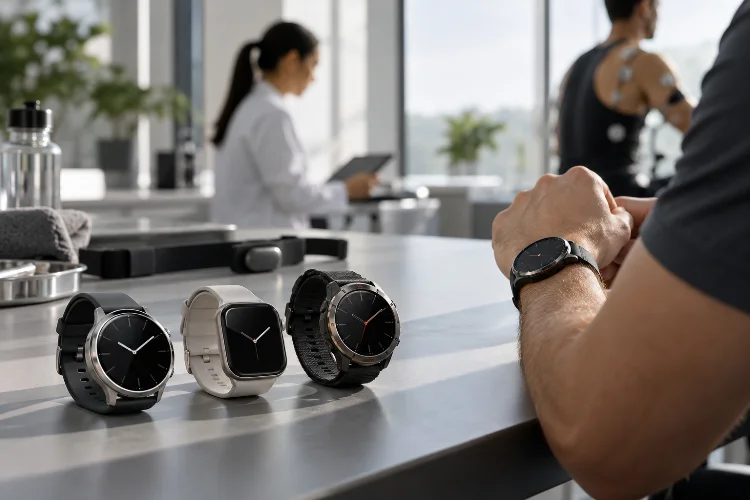
Premium smartwatches can now record an impressive collection of data. Heart rate, blood oxygen, ECG traces, skin temperature, sleep stages, running distance, elevation, stress estimates, and calorie expenditure can all appear on your wrist within seconds.
The difficult question is how much confidence you should place in those numbers.
Understanding sensor accuracy across premium smartwatches requires more than comparing which brand has the largest sensor array. Accuracy changes depending on the measurement, activity, environment, device fit, user physiology, and the algorithms processing the raw signal.
Research increasingly shows that modern watches can measure some variables – particularly heart rate under favourable conditions – quite well. Other metrics involve much more estimation.
A 2026 validation study of commercial wearables, for example, found substantial differences in optical heart-rate accuracy between devices and activities. Meanwhile, research comparing watches with laboratory equipment has found much weaker agreement for estimates such as energy expenditure.
The smartest way to evaluate a smartwatch is therefore metric by metric rather than assuming the entire device is either “accurate” or “inaccurate.”
Heart Rate Is Often One of the Strongest Measurements
Heart-rate monitoring is one of the most mature smartwatch sensing technologies.
Most premium watches use photoplethysmography, or PPG. LEDs illuminate the skin while photodetectors track changes in blood volume associated with each pulse.
Under relatively stable conditions, modern optical sensors can perform impressively.
A 2026 study comparing ten wearables with ECG-derived heart rate found mean absolute errors of 4.5 bpm for the Fitbit Charge 6 and 4.9 bpm for the Pixel Watch 2, while other tested devices showed larger errors. The researchers also found that activity type had a significant effect on accuracy.
A separate study involving Apple, Samsung, Fitbit, and Garmin devices found good heart-rate performance during endurance exercise across the watches tested. During resistance exercise, however, differences became more obvious, particularly around rapidly changing heart rates.
This makes sense mechanically.
Running with relatively regular arm motion can create a cleaner signal than weightlifting, rowing, or exercises involving tight gripping and repeated wrist flexion.
So heart-rate accuraccy should never be judged by one resting measurement.
Movement Can Turn an Excellent Sensor Into a Noisy One
Optical sensors are extremely sensitive to physical contact.
If a watch shifts slightly during running, the photodetector may receive changes caused by movement rather than blood flow. Algorithms have to separate those motion artifacts from the genuine pulse signal.
Garmin specifically warns about a phenomenon called cadence lock, where an optical sensor can mistakenly track running cadence instead of heart rate.
The company recommends wearing its watches securely above the wrist bone and using a chest strap when maximum exercise accuracy is required.
Apple provides similar advice, recommending a snug fit during exercise so the optical sensor maintains continuous skin contact. Samsung likewise recommends positioning compatible Galaxy Watches approximately one finger’s width above the wrist bone for more consistant readings.
This means two people wearing the same smartwatch can obtain different results.
Wrist anatomy, strap tightness, device position, temperature, tattoos, movement type, and even whether a user has warmed up can change signal quality.
Sensor hardware matters, but the way the device is worn matters too.
ECG Accuracy Is Different From Optical Heart-Rate Accuracy
Premium watches increasingly include ECG functionality, but ECG and optical heart-rate tracking should not be treated as the same measurement.
A typical smartwatch ECG uses electrical contacts to record a single-lead electrocardiogram when the user deliberately completes a measurement. Optical heart-rate monitoring usually operates automatically throughout the day.
Because ECG records electrical cardiac activity, it can provide information useful for identifying certain rhythm abnormalities. However, a wrist-based single-lead ECG is still much simpler than the multi-lead ECG systems used in hospitals.
This distinction matters when comparing watches.
A watch might have excellent optical heart-rate tracking but different ECG capabilities depending on hardware, software, regulatory approval, and region.
The broader lesson is that accuracy depends on what the sensor is designed to measure.
A device performing well during continuous heart-rate tracking does not automatically prove that every cardiovascular metric generated by its software has the same reliability.
Consumers should also distinguish between direct measurements and algorithmic interpretations built on top of those measurements.
Blood Oxygen Is More Sensitive to Measurement Conditions
Blood oxygen saturation is another common premium-watch feature, but wrist-based SpO₂ measurement has significant challenges.
Optical oxygen sensors typically use red and infrared light because oxygenated and deoxygenated haemoglobin interact differently with those wavelengths.
The basic science is established, but measurement conditions matter considerably.
The U.S. FDA notes that pulse-oximeter accuracy can be affected by factors including poor circulation, skin temperature, skin thickness, pigmentation, and other conditions.
The agency has also highlighted evidence of accuracy differences across skin pigmentation and proposed updated validation recommendations for medical pulse oximeters.
Smartwatch SpO₂ should therefore be treated carefully, particularly because wrist-based wearables are not necessarily equivalent to regulated fingertip medical devices.
Stillness is especially important.
This is one reason many watches collect oxygen measurements during sleep or quiet periods rather than relying exclusively on readings during intense movement.
A strange single measurment may reflect poor contact or temporary signal quality. Repeated trends collected under similar conditions are generally more informative than obsessing over one isolated value.
GPS Accuracy Depends Heavily on the Environment
Smartwatch accuracy is not only about biological sensors.
For runners, cyclists, and hikers, GNSS hardware can be just as important as heart-rate monitoring.
Outdoor positioning depends on satellite visibility, antenna design, chipset quality, frequency support, software filtering, and surrounding structures.
A 2026 study comparing smartwatch positioning against survey-grade equipment found a major environmental effect.
In dense urban conditions, horizontal positioning errors among the tested watches were substantially higher than under open-sky conditions, with urban-canyon RMSE values ranging from roughly 6.7 to 13 metres.
Tall buildings can reflect satellite signals before they reach the watch, producing multipath errors.
Forests and steep terrain can also reduce satellite visibility.
This explains why two devices may record nearly identical routes on an open running track yet produce noticeably different tracks through a downtown area.
Premium models using multi-band GNSS can improve performance in challenging conditions, but no wrist-sized receiver can completely remove environmental limitations.
For serious route comparison, evaluate watches seperately in open areas, urban environments, and wooded terrain.
Sleep, Calories, and Fitness Scores Rely More on Algorithms
Some smartwatch metrics are not measured directly at all.
A watch does not contain a tiny laboratory measuring calories burned. Instead, energy expenditure is estimated using combinations of heart rate, movement, age, body size, exercise type, and proprietary mathematical models.
This is where error can grow considerably.
A recent validation study comparing four commercial wearables with indirect calorimetry found very poor agreement for exercise energy expenditure across all tested devices, even though heart-rate performance was much stronger.
Sleep stages involve similar interpretation.
Accelerometers, heart-rate patterns, HRV, temperature, and other signals may be combined to estimate whether a person is awake or in particular sleep stages. But the reference method used clinically – polysomnography – measures considerably more physiological information.
A large systematic review of Apple Watch validation research similarly found that measurement quality varied considerably by metric: heart rate generally performed much better than energy expenditure, while sleep-stage agreement was more limited.
This does not make these features useless.
They can still be valuable for observing long-term trends. The important distinction is between a useful estimate and a precise direct measurement.
Hardware and Algorithms Must Work Together
It is tempting to compare watches by counting LEDs, photodiodes, electrodes, or satellite systems.
That only tells part of the story.
Raw sensor data must be filtered, corrected, classified, and interpreted by software. Manufacturers can improve performance through firmware updates even when the physical sensor hardware remains unchanged.
Sampling strategy matters as well.
A watch continuously recording high-resolution sensor data could theoretically collect more information, but doing so consumes additional battery power. Manufacturers therefore balance sampling frequency, signal quality, processing cost, and battery endurance.
Sensor fusion adds another layer.
Accelerometer data can help an optical sensor recognise movement artifacts. GPS and motion sensors can complement one another during exercise. Temperature and cardiovascular information may be combined when generating recovery or wellness insights.
This is why a newer sensor is not automatically superior.
The strongest devices combine capable hardware with mature algorithms and validation across different users, exercises, and environments.
How to Compare Smartwatch Accuracy Properly
Avoid judging sensor quality from a single online test.
A watch can perform brilliantly during steady running but poorly during weightlifting. Another may have excellent open-sky GPS but struggle between tall buildings.
Look for independent testing that compares measurements with an appropriate reference.
Heart rate should ideally be compared against ECG or a reliable electrical chest strap. Energy expenditure should be tested against indirect calorimetry. Sleep stages are best validated with polysomnography, while positioning can be compared with high-precision GNSS equipment.
Sample size matters too.
A test involving one person and one five-kilometre run can be interesting, but it cannot establish universal accuracy.
Finally, pay attention to the specific generation being tested. Sensors, algorithms, antenna systems, and firmware change regularly.
Rather than looking for one smartwatch that is “the most accurate at everything,” decide which measurements matter most to you and evaluate those specifically.
Premium smartwatches have become remarkably capable sensing devices, but their accuracy is not uniform across every metric or situation.
Heart-rate tracking can be highly reliable under favourable conditions, while movement, poor fit, and rapidly changing exercise intensity can increase errors.
SpO₂ and GNSS measurements depend strongly on environmental and physiological conditions, while metrics such as calories and sleep stages involve additional algorithmic estimation.
When choosing a smartwatch, look beyond the number of health features listed in the specifications. Check independent validation against appropriate reference equipment and consider the activities you actually perform.
Most importantly, use wearable data for what it does best: identifying patterns and trends over time. A consistant long-term signal can often be more useful than treating every individual number as laboratory-grade truth.