
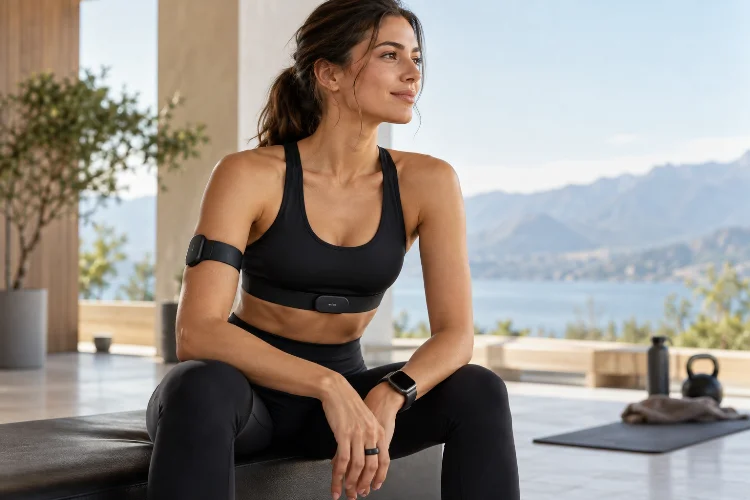
Wearable devices can contain impressive sensors, but where those sensors sit on the body can be just as important as the hardware itself.
A heart-rate sensor on the wrist, a motion sensor near the waist, and an ECG electrode on the chest are all observing different physiological or mechanical signals.
That is why understanding how sensor placement influences wearable data reliability is essential when evaluating smartwatches, fitness bands, rings, patches, and professional monitoring systems.
Placement changes blood-flow characteristics, movement artifacts, skin contact, temperature exposure, and even the type of body motion a sensor can detect.
Research on wearable photoplethysmography shows that pulse signals measured at the wrist differ from those measured at the finger, while some alternative locations can provide stronger signals or lower susceptibility to motion.
In other words, a sensor does not measure the body in some universal way. It measures what is happening at one specific location, and software then tries to interpret that information accurately.
Wrist Placement Is Convenient but Technically Challenging
The wrist has become the dominant location for consumer wearables because it is comfortable, familiar, and practical for continuous use.
From an engineering perspective, however, it is not always the easiest measurement site.
Optical heart-rate sensors use photoplethysmography, or PPG, to observe changes in blood volume beneath the skin.
Research shows that wrist PPG signals generally have lower amplitude than signals obtained from locations such as the finger, partly because the underlying vascular structures are different.
The wrist also moves constantly.
Running, lifting weights, typing, cycling, or simply swinging an arm can change pressure between the sensor and skin. These movements introduce artifacts that algorithms must distinguish from genuine cardiovascular signals.
This is why placement a little above the wrist bone matters.
Apple recommends wearing its watch snugly on top of the wrist, above the wrist bone, so the optical and electrical sensors maintain reliable skin contact.
Good placement cannot eliminate every error, but it gives the sensor a much cleaner starting signal.
Finger Sensors Often Get Stronger Optical Signals
Fingers are excellent locations for optical cardiovascular sensing because they contain dense vascular structures and can produce strong pulsatile signals.
This is one reason traditional pulse oximeters are commonly placed on a fingertip.
PPG research identifies the finger as one of the locations capable of producing relatively strong optical pulse signals, although it is less convenient for continuous everyday monitoring because people use their hands constantly.
Smart rings attempt to take advantage of this location.
Because a ring can maintain relatively stable contact with the finger, it may experience different motion and optical conditions from a smartwatch. However, finger motion, fit, temperature, and circulation can still affect measurements.
The lesson is not that finger wearables are automatically more accurate.
It is that sensor location changes the biological signal available to the device. Wrist and finger devices may therefore behave differently even when they use similar optical technology.
Strap Tightness Changes Optical Sensor Quality
Location alone is not enough. The sensor must also maintain appropriate contact with the skin.
A watch that is too loose can slide around, allowing motion and external light to interfere with the optical signal. One that is excessively tight can restrict local blood flow, creating another source of measurement problems.
Google’s Fitbit guidance recommends wearing compatible devices on top of the wrist with the sensor in direct contact with the skin.
During exercise, the company recommends a slightly tighter and higher position because frequent wrist bending can interfere with heart-rate measurements.
Garmin gives similar advice. Its guidance recommends wearing the device above the wrist bone, snug enough that it does not shift during exercise.
Garmin also notes that activities involving heavy wrist flexion, such as rowing, cycling, weightlifting, and racket sports, can reduce optical heart-rate accuraccy.
This is why simply switching straps can sometimes change results.
A comfortable, stable fit can improve signal reliability without changing any electronics inside the wearable.
ECG Measurements Depend on Electrode Position
Electrical heart sensing is even more sensitive to location.
An ECG records electrical potential differences generated by cardiac activity. The waveform produced depends partly on where electrodes are placed relative to the heart.
Clinical ECG systems use carefully defined electrode positions for exactly this reason.
A review of remote and wearable ECG technologies notes that changes in electrode placement can alter ECG morphology, and even relatively small positional shifts may produce noticeable differences in the recorded waveform.
Smartwatches usually simplify this process.
Many models form a circuit between an electrode on the back of the watch and another electrode touched by a finger on the opposite hand. This arrangement produces a tracing broadly analogous to a single ECG lead.
The limitation is important.
Moving the watch to another body location can produce a different electrical perspective. Researchers have even experimented with smartwatch placement on the abdomen and chest to recreate additional ECG-like leads.
For everyday users, this means following the manufacturer’s recommended position is critical for a consistant ECG recording.
Motion Sensors Must Match the Movement Being Measured
Placement becomes even more complicated with accelerometers and gyroscopes.
A motion sensor attached to the wrist captures wrist movement extremely well, but wrist motion is not identical to movement at the waist, chest, ankle, or foot.
Consider walking.
A sensor near the waist follows the body’s centre of mass relatively closely. A wrist sensor also records arm swing, which can help recognise walking but can become confusing when someone pushes a shopping cart or carries an object.
Research on wearable activity monitoring shows that sensor location directly influences activity-recognition accuracy. Different body positions can be better suited to recognising specific movements.
Gait analysis provides another example.
A systematic review of wearable inertial sensors found that placement and signal selection can significantly affect agreement with laboratory motion-capture systems.
For detailed biomechanical work, researchers may place sensors on the feet, shins, thighs, waist, or torso instead of relying on one smartwatch.
The best location depends on what movement you are trying to observe.
Soft Tissue Can Introduce Motion Errors
Even placing a sensor on the correct body region does not guarantee perfect motion data.
Sensors attached over soft tissue can move slightly relative to the underlying bone.
This is known as soft-tissue artifact and can affect estimates of joint position and movement.
Research into wearable sensors for knee rehabilitation has highlighted the importance of carefully choosing anatomical placement. Some studies position IMUs over areas where movement relative to the bone is reduced to improve repeatability.
The attachment method matters too.
A sensor loosely clipped to clothing may move differently from a device firmly attached to the body. A review of wearable motion-monitoring systems notes that poor or unstable body contact can reduce monitoring accuracy.
This becomes especially important for rehabilitation, sports science, and clinical research.
For ordinary consumer activity tracking, algorithms can compensate for some movement. For precise joint-angle measurment, much stricter placement is necessary.
Temperature Sensors Measure Local Skin Conditions
Temperature is another metric where sensor position dramatically changes interpretation.
Skin temperature is not uniform across the body.
Hands and feet can cool rapidly due to changes in circulation, while the torso usually behaves differently. Environmental exposure also affects body regions differently depending on clothing and airflow.
Research using multiple wearable temperature sensors has shown that estimates of proximal and distal skin temperature depend strongly on which body locations are included.
This explains why wrist temperature should not automatically be interpreted as core body temperature.
Wearable systems often use local temperature as a trend rather than claiming that the sensor directly measures internal body temperature.
Researchers exploring core-temperature estimation frequently combine skin temperature with other measurements and algorithms. A systematic review found that many systems used chest-mounted sensors, while others used wrist measurements or multiple sensor locations.
Placement therefore determines what the temperature sensor is actually telling you.
The Best Location Depends on the Metric
There is no universally perfect place to wear every sensor.
The wrist is convenient and supports continuous tracking, which is why it dominates consumer electronics. The finger can provide strong optical pulse signals.
The chest is well suited to electrical cardiac measurements and certain respiratory or temperature-monitoring systems. The waist can be useful for body-motion classification, while ankles and feet are valuable for gait analysis.
Research into wearable PPG similarly identifies potential measurement sites ranging from the wrist and fingers to the arm, ear, chest, and face. Each has different strengths and limitations.
This creates an important trade-off between theoretical signal quality and practical usability.
A chest patch might produce excellent data, but many users would prefer wearing a watch every day. A fingertip sensor can be highly useful for a short oxygen measurement but inconvenient for continuous activity tracking.
The most successful wearable is therefore not necessarily placed where the signal is scientifically strongest.
It is placed where signal quality, comfort, battery life, and long-term wearability reach a useful balance.
Consistent Placement Improves Long-Term Trends
For consumer wearables, repeatability can be as valuable as absolute perfection.
If you wear a watch in roughly the same position and with similar strap tension every day, measurements are collected under more consistant conditions.
That makes trends easier to interpret.
Moving a device between wrists, changing the fit dramatically, or wearing it in different positions during different workouts can introduce additional variation unrelated to actual physiological changes.
This does not mean users need laboratory-level placement precision.
Instead, follow the manufacturer’s fitting guidance and keep measurement conditions reasonably similar when comparing trends over time.
Wearables are especially valuable because they collect repeated data across days, weeks, and months.
Reliable placement helps ensure those changes reflect your behaviour or physiology rather than simply a sensor that moved to a different part of the body.
Sensor placement has a major influence on wearable data reliability because every location produces a different combination of physiological signals, motion artifacts, skin contact, and environmental exposure.
The wrist offers convenience but can suffer from movement. Fingers often produce stronger optical signals, while chest locations are valuable for electrical and physiological monitoring.
Motion sensors must also be positioned according to the movement being studied, and temperature measurements depend heavily on local skin conditions.
For everyday users, the simplest improvement is also one of the most effective: wear the device where and how the manufacturer recommends.
For researchers and professionals, placement should be selected according to the exact metric being measured. Better placement does not just improve the sensor – it improves the quality of every decision built on that data.